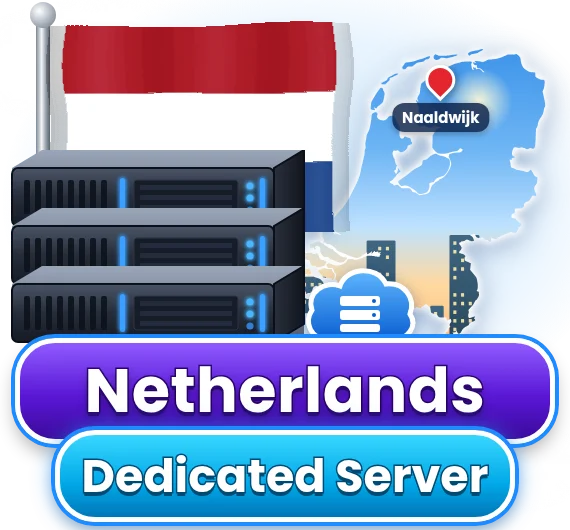
Dedicated Server Hosting in the Netherlands

The Netherlands is one of the best-connected places on the planet for internet infrastructure, and a dedicated server there puts your application a short hop away from most of Western Europe. Our Dutch machines are racked in a Tier III+ facility in Naaldwijk, in the province of South Holland, between Rotterdam and The Hague. The site links into a backbone with a combined capacity of around 10 Tbit/s and sits behind a 40 Gbit DDoS shield, so hostile traffic is scrubbed before it can touch your port. Every server is a physical box reserved for you, from a four-core Xeon E3 with 16 GB of ECC memory to an eight-core AMD Ryzen 7 with NVMe storage. Traffic allowances of 50 to 100 TB on a 1 Gbit/s uplink cover even demanding download portals, streaming origins and SaaS platforms. Most orders go live within 6 to 12 hours, contracts run month to month, and you keep complete root or Administrator control from the moment the credentials arrive.

Plans from $74/mo · Naaldwijk, South Holland
Tier III+ in South Holland
40 Gbit DDoS Shield
Up to 100 TB Traffic
6–12 Hour Deployment

Dutch Bare-Metal Plans and Monthly Prices

Six configurations cover the range from lean single-socket machines to multi-core workhorses. The Xeon E3-1230v2 and E3-1240v5 models are popular for web hosting, VPN gateways and small game servers, while the Xeon E-2236 and dual E5-2620v4 systems give more threads for databases and container clusters. At the top, the Ryzen 7 3700X pairs strong single-thread speed with a 500 GB NVMe drive for latency-sensitive applications. Each plan includes a 1 Gbit/s port with either 50 TB or 100 TB of monthly transfer.

ProcessorCoresMemoryStorageBandwidthIPv4Price
Intel Xeon E3-1230v2 3.30Ghz 4C / 8T 16GB ECC DDR3 120GB SSD 50TB1Gbit/s 1 $74/moOn sale - Save 12% ORDER NOW
Intel Xeon E3-1240v5 3.50Ghz 4C / 8T 32GB ECC DDR4 250GB SSD + 2TB HDD 50TB1Gbit/s 1 $99/moOn sale - Save 15% ORDER NOW
Intel Xeon E3-1230v6 3.50Ghz 4C / 8T 16GB ECC DDR4 1TB HDD 100TB1Gbit/s 1 $129/mo ORDER NOW
Intel Xeon E-2236 3.40Ghz 6C / 12T 32GB ECC DDR4 2 x 2TB HDD SATA 100TB1Gbit/s 1 $169/moOn sale - Save 20% ORDER NOW
2x Xeon E5-2620v4 2.10Ghz 16C / 32T 32GB ECC DDR4 1TB HDD SATA 100TB1Gbit/s 1 $197/moOn sale - Save 35% ORDER NOW
AMD Ryzen 7 3700X 3.60Ghz 8C / 16T 32GB ECC DDR4 500GB NVMe SSD 50TB1Gbit/s 1 $239/mo ORDER NOW

All prices are per month in US dollars with a one-month minimum term. Discounted plans show the saving next to the price; the reduced rate continues for as long as the server remains active.

Inside the Naaldwijk Facility

Naaldwijk lies in the Westland area of South Holland, a short distance from the major Amsterdam and Rotterdam network hubs. The data centre is built to Tier III+ standards with redundant power paths, cooling and connectivity, which allows maintenance without taking customer equipment offline. Its network edge is protected by a 40 Gbit DDoS mitigation layer, and connectivity is provided over a backbone rated at roughly 10 Tbit/s. The key service facts for every Dutch dedicated server are summarised in the table.

FacilityTier III+ data centre, Naaldwijk (South Holland)
Uplink speed1 Gbit/s dedicated port
Monthly transfer50 TB or 100 TB depending on plan
Attack mitigation40 Gbit network-level DDoS shield
Backbone capacityApproximately 10 Tbit/s
IP allocation1 Dutch IPv4 included, extra on request
ProvisioningTypically 6–12 hours after payment
Minimum termOne month, renewable monthly
Netherlands Dedicated Server

Benefits of Hosting Your Server in Holland

The Dutch market attracts hosting customers from every continent. These advantages explain why so many teams choose a physical server in the Netherlands.

Central Position in Western Europe

From South Holland, traffic reaches Belgium, Germany, France and the United Kingdom over short fibre paths, making one server practical for an audience spread across several EU states.

Protection Against Floods

The 40 Gbit mitigation layer filters volumetric attacks at the network edge, so a targeted flood does not saturate your port or force an emergency migration.

Generous Transfer Quotas

With 50 to 100 TB included each month, file mirrors, video origins and software update servers can operate for weeks without approaching their limit.

Fast Turnaround

Servers are usually online within half a working day, which is helpful when a launch date is close or an existing host has let you down.

Choice Between Intel and AMD

Pick classic Xeon reliability, modern Xeon E-series efficiency or the high clock speed of AMD Ryzen, depending on how your software uses threads.

Storage Inside the European Union

Keeping data on hardware inside the Netherlands helps organisations meet GDPR expectations and customer requests for European storage.

Flexible Month-to-Month Terms

There is no annual lock-in; scale up to a larger chassis or add a second machine whenever traffic grows, and cancel when a project ends.

Strong Peering Ecosystem

Dutch networks exchange traffic directly with thousands of providers, which shortens routes to end users and reduces the chance of congested transit links.

Hardware and Network Specifications in Naaldwijk

These technical characteristics apply across the Dutch dedicated range and explain how the servers stay fast and available.

ECC Memory on Every Plan

Error-correcting DDR3 or DDR4 memory detects and fixes single-bit faults automatically, preventing silent data corruption in databases and long-running processes.

NVMe and Hybrid Storage

Choose SSD-only, NVMe or combined SSD plus HDD layouts, pairing a fast system drive with large spinning disks for backups and media.

Dedicated 1 Gbit/s Uplink

Each machine connects through its own gigabit port rather than a shared virtual interface, providing consistent throughput for downloads and replication.

Always-On Mitigation

DDoS filtering runs continuously in front of the network, detecting attack patterns automatically instead of waiting for manual activation.

Remote Management Access

Out-of-band tools let you restart hardware and reinstall operating systems without waiting for a technician, even if the server stops responding.

Redundant Power and Cooling

Dual power paths, UPS systems and generators keep equipment running through utility interruptions, supported by N+1 cooling in the data hall.

Popular Projects on Dutch Dedicated Hardware

Netherlands servers support a wide mix of international workloads. These examples reflect how customers typically use them.

Pan-European SaaS Platforms

Software vendors serving clients in Berlin, Paris, Brussels and London often host their production stack in South Holland. The central location keeps response times balanced across markets, and dedicated CPUs mean one heavy customer report never slows down the application for everyone else sharing the platform.

Download Mirrors and Update Servers

Open-source projects, game studios and software companies distribute installers and patches from Dutch machines. The 50 to 100 TB transfer allowances absorb release-day spikes, and the gigabit uplink moves large files quickly to users throughout Europe and beyond.

Protected Game Hosting

Multiplayer communities running Minecraft, Rust, CS2 or FiveM servers frequently face attacks from rival players. The always-on 40 Gbit shield helps keep matches online, while high-frequency Xeon and Ryzen processors provide the single-thread speed many game engines rely on.

Private Cloud and Virtualisation

Hosting companies and IT teams install Proxmox or VMware on the dual Xeon and Ryzen models to create their own virtual machine clusters. Owning the physical host lets them control oversubscription, backup schedules and network isolation for every tenant.

Supported Operating Systems in the Netherlands

When you order, simply choose the operating system you want and it will be installed before handover. Free open-source systems, including the Debian family and the RHEL-compatible Alma and Rocky releases, carry no licence cost and are the usual base for web stacks, containers and SQL engines. Microsoft's 2019 and 2022 server editions can be preinstalled as well; their licence is charged per physical core, which matters when comparing the Ryzen and dual-Xeon options. You can also request a hypervisor like Proxmox VE or VMware ESXi, or mount a custom ISO through the remote management console if your project depends on a niche system.

  • Ubuntu LTS or Debian stable releases
  • RHEL-compatible AlmaLinux / Rocky
  • Windows Server 2019 and 2022
  • Proxmox VE, VMware ESXi or custom ISO
  • cPanel, Plesk and DirectAdmin on request

Why Teams Trust ServerSlot for Dutch Hosting

ServerSlot has operated Netherlands infrastructure for many years and supports customers ranging from solo developers to hosting resellers. We handle the physical side of the service: rack space, power, network, attack mitigation and hardware replacement. You manage the software with complete administrative control. Our ticket desk is staffed at all hours, and engineers can escalate directly to the on-site team in Naaldwijk when hands-on work is needed. Billing is transparent, with no setup charges on standard plans, and payment is accepted by card, PayPal or cryptocurrency.

Low-Cost Dutch Servers With Premium Connectivity

Hosting in Western Europe is often assumed to be expensive, yet our Dutch range starts at just $74 per month for a Xeon E3 with 16 GB of ECC memory and 50 TB of transfer. Several plans carry permanent on-sale discounts of up to 35 percent, clearly marked in the table. Because attack filtering, a gigabit port and generous traffic are included rather than sold as add-ons, the total cost of ownership stays low even for busy sites. If your needs change, moving to a larger configuration within the same facility keeps your network design intact.

Fast Routes to London, Frankfurt and Paris

South Holland is within a few milliseconds of Amsterdam and connects directly into major European internet exchanges. Visitors in London, Frankfurt, Paris and Brussels therefore reach a Naaldwijk server very quickly, and even users in North America benefit from the numerous transatlantic cables landing near the Dutch coast. For global projects that need one strong European anchor, few locations match it.

Transfer Quotas Versus 95th Percentile Billing

Dutch hosting offers come in two main flavours, and mixing them up can lead to unexpected invoices. A transfer quota counts the total volume of data leaving your server in a month, measured in terabytes. Once you know roughly how many gigabytes your users download per day, you can estimate monthly use with simple multiplication.

Burstable or committed bandwidth, common in colocation and carrier contracts, often uses the 95th percentile method instead. Traffic is sampled every five minutes, the top five percent of samples are discarded and the highest remaining value sets the bill. Short spikes are forgiven, while sustained high throughput is not. To plan either way, graph your outbound traffic with vnStat or your monitoring stack for a few weeks. Look at average rate, peak rate and monthly total together, because a download mirror and an API backend with the same total can have very different shapes.

Renting Versus Colocating in South Holland

The Westland and Rotterdam area hosts a good number of facilities, so some teams wonder whether to buy their own hardware and colocate it rather than rent. Colocation gives full control over components and can be cheaper over a long hardware life, but it brings upfront capital cost, shipping, remote hands fees and the job of handling failed parts yourself.

Renting moves those burdens to the provider. You can change configuration when needs shift, hardware replacement is someone else's task and there is nothing to depreciate on your balance sheet. A useful rule of thumb is to compare total cost over three years, including your own staff time for maintenance and spares. Colocation tends to make sense when you run many servers with specialised parts. For one to a handful of machines, or for workloads still finding their size, rental usually keeps life simpler while you learn what you really need.

Measuring Latency to Naaldwijk Before You Order

Rather than relying on a map, test the network path from the places your users actually sit. Ask our team for a test IP address in the Dutch facility, then run ping and mtr from a few representative locations, such as an office connection, a home broadband line and a mobile hotspot. Mtr shows each hop and highlights where delay or packet loss appears.

Run each test in the morning and again late in the evening, since busy residential networks after dinner can shift results noticeably. If your audience spans several countries, free measurement networks such as RIPE Atlas let you run checks from probes across Europe without owning any hardware there. Compare the figures with your current host to see whether a move is worthwhile. For web applications, also measure time to first byte with curl, since server processing time often matters as much as network distance once both ends are in Western Europe.

Warming Up a Fresh Dutch IP for Email

Gmail, Outlook and other big inbox operators are wary of an address they have never seen deliver mail, and your new Naaldwijk IP starts with a blank record. Before sending any volume, set up the basics: a reverse DNS record that matches your mail hostname, an SPF record listing the server, DKIM signing and a DMARC policy, starting in monitoring mode.

Check the address against common blocklists on day one, since recycled IPs occasionally carry an old reputation. Then increase volume gradually. Start with transactional messages to engaged recipients, such as password resets and order confirmations, and add newsletters only after a week or two without problems. Register with postmaster tools where the big providers offer them so you can see complaint rates. Keep bulk marketing on a separate address or service from critical transactional mail, so a campaign that annoys readers cannot delay a customer's receipt. Watch bounce logs closely during the first month.

Netherlands Dedicated Server FAQ

Everything you may want to confirm before ordering a Dutch bare-metal machine.

Where exactly is the Netherlands data centre?

The hardware lives in Naaldwijk, part of the Westland greenhouse district that sits between Rotterdam and The Hague, inside a data hall engineered to Tier III+ requirements. The building offers redundant power, cooling and network paths, and it connects to backbone capacity of around 10 Tbit/s. IP addresses assigned to your server are registered in the Netherlands, so geolocation services will generally show a Dutch location. If you require a specific city in the IP metadata for a particular project, please ask before ordering and we will confirm what can be arranged for your subnet.

How does the 40 Gbit DDoS protection work?

Incoming traffic passes through a mitigation platform at the edge of the network that can absorb up to 40 Gbit/s of malicious data. It recognises common attack patterns such as UDP floods, SYN floods and reflection attacks and drops them before they reach your server, while genuine visitors continue to connect. Filtering is always active, so there is no need to request it during an attack. For complex application-layer attacks, we suggest adding a reverse proxy or web application firewall on your own server to complement the network protection.

What is the difference between the 50 TB and 100 TB plans?

Every Dutch server has a 1 Gbit/s port, but the monthly transfer allowance varies by configuration. Entry models include 50 TB, while several higher tiers include 100 TB. That amount covers most websites, APIs and even busy download mirrors many times over. If you ever approach the limit, our team will contact you to discuss an upgrade before any throttling or extra charges apply. Choose the 100 TB plans if you distribute large files, run a video origin, or replicate backups between locations every day.

Can I run game servers on a Dutch dedicated machine?

Yes. Game hosting is one of the most common uses for our Netherlands hardware. The central European location gives balanced ping to players across the continent, and the always-on DDoS shield helps protect matches from disruption. For titles that depend heavily on single-core speed, the Xeon E-2236 or AMD Ryzen 7 3700X configurations are excellent choices. You can install SteamCMD, Pterodactyl or any other panel yourself with full root access, and run several game instances side by side as long as resources allow.

How quickly will my Netherlands server be ready?

In most cases the server is handed over within 6 to 12 hours after your payment is confirmed. During provisioning the hardware is checked, the requested operating system is installed and the network configuration is applied. You will then receive login details and the IP address by email. Custom requests, such as additional disks or a particular RAID setup, can extend the timeline slightly, and we will let you know in advance. Out-of-stock models may take longer, but our team always suggests alternatives if you are in a hurry.

Is my data stored under EU law?

The server is physically located in the Netherlands, an EU member state, which means stored data is subject to European data protection rules, including GDPR. This is useful for companies that promise European customers their information will not leave the region. As the operator of your own server, you remain the data controller and are responsible for configuring encryption, access policies and retention correctly. We provide the infrastructure and do not access the contents of your system unless you explicitly ask for assistance.

Can I upgrade to a larger configuration later?

Yes. Because each plan is a separate physical machine, upgrading means moving to another server with more cores, memory or storage. We can provision the new hardware alongside the old one so you can migrate data at your own pace, and then cancel the original server once everything is running. RAM or disk additions are sometimes possible on the same chassis, depending on the model. Contact support with your target specification and we will recommend the smoothest path with minimal downtime for your users.

Which payment methods do you accept for Dutch servers?

We accept major credit and debit cards, PayPal and several cryptocurrencies including Bitcoin. Billing is monthly by default, with the invoice issued ahead of each renewal date. There are no setup fees on standard configurations and no long-term contract, so you can cancel before the next billing cycle if you no longer need the machine. For businesses that require invoices with specific details, you can add company information to your client area profile and it will appear on every future invoice automatically.

Nearby server locations

Explore Other European Server Locations

Submit a ticket