Can I use DigiD from the Dutch desktop?
Yes. DigiD works in a browser on your Meppel desktop, and you authenticate with the DigiD app on your phone, usually by scanning a QR code or entering a code. The Dutch IP provides a consistent local connection. Expats who have left the Netherlands commonly use the desktop to file their final tax return, apply for allowances refunds and access MijnOverheid messages. Dutch emigrants use it for SVB pension matters and municipal requests. DigiD itself remains secured by your phone.
Which Dutch banks work from the desktop?
Internet banking from ING, Rabobank, ABN AMRO, SNS, ASN, Triodos and bunq works in a browser on the desktop. Logins and payments are confirmed through each bank's app or a card reader, so your phone or reader remains the key to your account. The Dutch IP helps avoid extra checks that foreign logins can trigger. Expats keep accounts open for months after leaving to receive final salaries and tax refunds, and the desktop makes managing them easier. Tikkie payment requests from friends can also be paid through the session.
Is bandwidth unlimited on Meppel desktops?
Yes. We never count or cap traffic on Dutch desktops, and there are no overage charges. Upload and download as much as your work requires, whether that is syncing cloud drives, sending large design files or backing up data. Our terms prohibit spam and attacks, but legitimate use of any volume is welcome. Combined with NVMe storage, this makes the desktop fast and practical for agencies and developers. Dutch agencies sending video productions to clients across Europe often transfer several terabytes a month without any change to their bill, and developers mirroring large container registries benefit in the same way. Since the Netherlands sits on some of Europe's most important network routes, transfers to Belgium, Germany and the UK move quickly.
Can zzp'ers run their administration on the desktop?
Yes. Many Dutch freelancers use the desktop for Moneybird, e-Boekhouden, Exact Online or Jortt, and store invoices, receipts and contracts securely. The desktop is accessible from home, a co-working space or abroad, so your administration is always in one place. When filing quarterly VAT returns, you log in to the Belastingdienst with DigiD as usual. For freelancers who also design or code, the four-core sizes provide extra headroom. Clients and your accountant can be given separate logins, and backups of your administration can be scheduled to cloud storage so the seven-year retention requirement for business records is easy to meet.
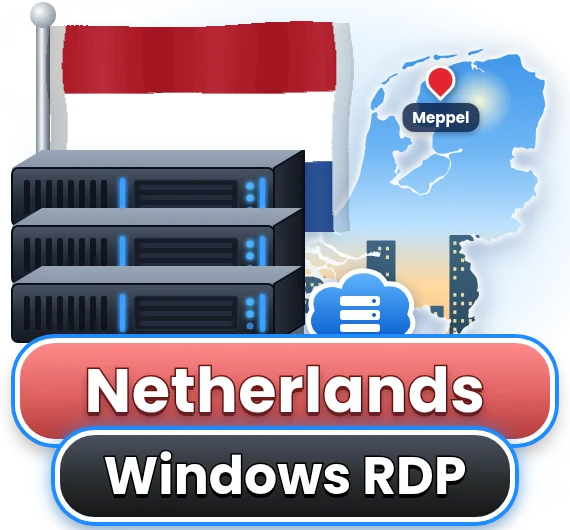
Why is the desktop in Meppel rather than Amsterdam?
Meppel offers reliable infrastructure with fibre connections to Amsterdam's internet exchanges and Groningen, along with lower costs than central Amsterdam. For remote desktop users, the difference in latency is negligible, as traffic reaches Amsterdam within a few milliseconds. The IP is Dutch in every respect, so Dutch services treat it as local. Drenthe and the wider north of the Netherlands have developed into a significant data centre region, thanks to strong grid connections, available land and fibre networks linking Groningen, Zwolle and Amsterdam. Hosting there spreads infrastructure away from the crowded Amsterdam metro area, where grid capacity has become scarce, while providing equally good connectivity to customers across Europe.
Can I handle my final Dutch tax return after leaving the country?
Absolutely; emigrants ask us about this constantly. People who emigrate from the Netherlands file an M-form, a special income tax return covering the year in which they moved, and it can be complex because it splits the year into resident and non-resident periods. You log in to Mijn Belastingdienst with DigiD on the desktop, download the M-form software or use the online version, and submit it from a Dutch connection. Expats who benefited from the 30% ruling often need to file this return as well. Letters and assessments can arrive many months later, so keeping a Dutch desktop for the following year means you can respond promptly and store every document in one place.
Can I type Dutch characters easily?
Yes. Most Dutch users use the US-International keyboard, which lets you type characters like ë, é and ï using dead keys. You can also add the Dutch keyboard layout if you prefer. The Windows interface can be switched to Dutch, and regional settings can show euro amounts and Dutch date formats. Office proofing tools support Dutch spelling. Frisian is also supported for users in Friesland. For international teams, each user can choose their own interface language and keyboard, so English-, Dutch-, Polish- and Turkish-speaking colleagues can share one Server desktop comfortably. Regional settings ensure that invoices show the euro sign and Dutch decimal commas correctly, which matters for bookkeeping and official correspondence with the Belastingdienst.
Is the Netherlands a good base for European teams?
Yes. The Netherlands has excellent connectivity to the rest of Europe, with short routes to Belgium, Germany, the UK, France and Scandinavia. Teams spread across Western Europe can share a single desktop with low latency. Many international companies already have Dutch entities, so a desktop here suits their finance and administration needs. Companies also value Dutch legal stability and an English-speaking workforce, which make the Netherlands a common choice for European headquarters. Placing the shared desktop in the same country as the legal entity keeps data residency simple for auditors and helps finance teams demonstrate GDPR compliance. If you also need British or German services, our UK and Frankfurt desktops sit only a few milliseconds away.